Why Great Product Execution Doesn't Guarantee Capital Access
The narrative infrastructure gap that's costing you for your next round

The best product leaders I know shipped consistently, hit their metrics, and solved real problems. However, majority of them couldn’t raise capital to scale their business.
The gap wasn’t execution. It was narrative infrastructure.
And if you’re a product leader who learned your craft at a scale (think FAANG), you probably don’t even know this gap exists.
The secret sauce you’re missing.
Something revealing happened in AI venture capital in 2025 and continuing in 26.
DeepSeek, a Chinese AI lab, achieved an $16 billion valuation with a model that performed comparably to GPT-4 at claimed 1/10th the training cost. The narrative wasn’t about superior performance. It was about geopolitical inevitability: “Chinese AI can compete with Western labs on both capability and efficiency.”
Cursor, the AI coding assistant, is commanding premium valuations not because it demonstrated materially better code completion than GitHub Copilot. The narrative is “AI-native development environments will replace traditional IDEs.” That’s a category transformation story, not a feature comparison.
Figure’s humanoid robots secured major automotive partnerships in late 2025 based on “embodied AI + manufacturing labor shortage = inevitable,” not demonstrated ROI from current deployments.
Meanwhile, teams with strong retention curves, real revenue growth, and validated product-market fit are getting passed over or raising at compressed valuations.
Why?
Investors aren’t buying what you’ve built. They’re buying your alignment with where they believe the world is going.
This is the difference between Product-Market Fit and Narrative-Market Fit.
PMF proves you can solve problems people have today. It shows up in retention, NPS, revenue growth, customer testimonials. It’s backward-looking validation.
NMF proves you understand where the category is heading and why your execution positions you to capture that future. It’s forward-looking inevitability.
Execution gets you PMF. Narrative gets you the capital to scale PMF.
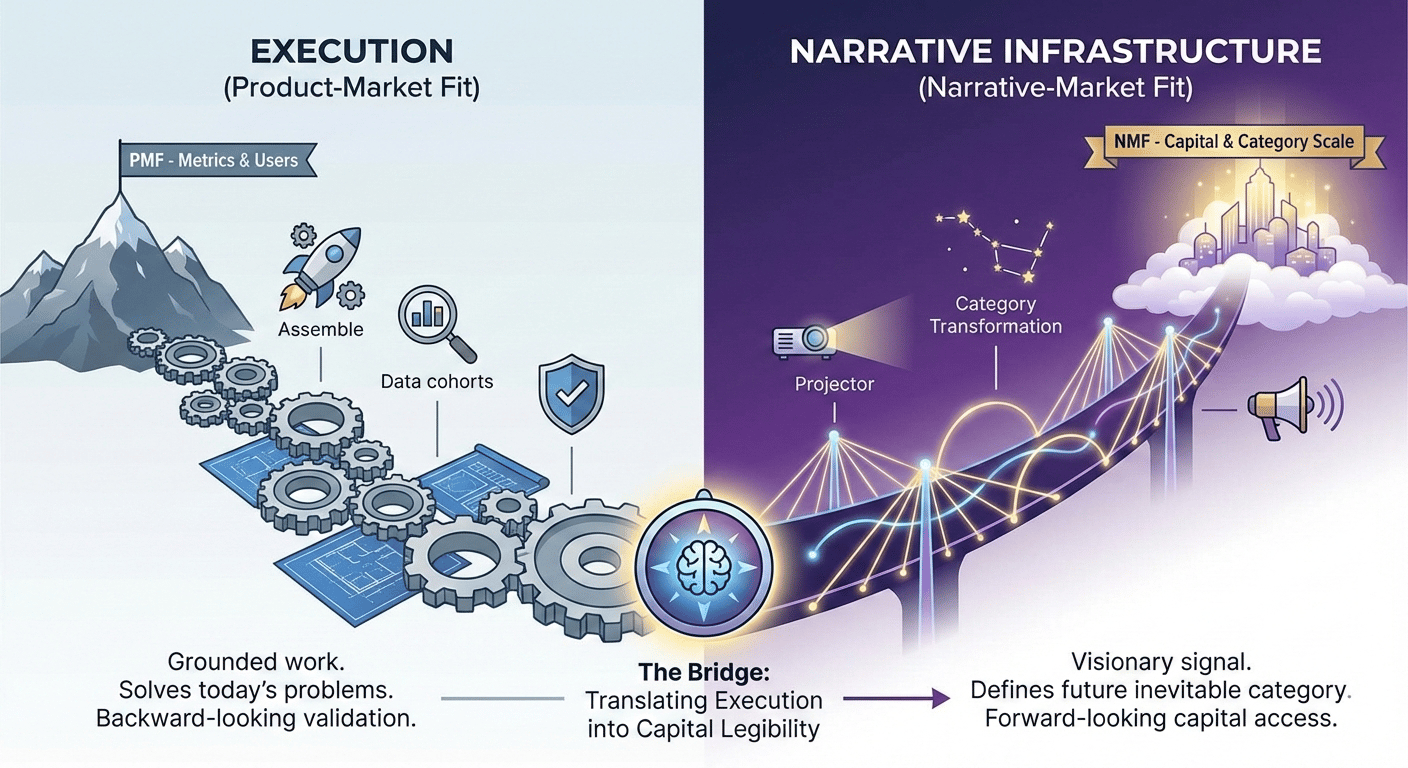
And here’s what most product leaders miss: narrative infrastructure isn’t a marketing problem. It’s a product roadmap problem.
Why Product Leaders Systematically Under-Invest
Most senior product leaders think their job is execution. Features, metrics, experiments, launches, stakeholder alignment. Translating technical complexity into shipped products that drive business outcomes.
But there’s a second muscle that you need to develop, i.e. translating execution into capital narratives.
You can explain to your VP why a feature matters for Q4 retention targets. But can you explain to an investor why it signals inevitable category transformation?
Different audience. Different time horizon. Different success criteria.
And here’s the trap that results in technical product leaders failure, they think Narrative work is marketing theater.
They believe, that if you build great features, analyze cohorts, run A/B tests, debug edge cases, optimize conversion funnels, then that is real work. Tangible. Measurable. Direct impact.
Writing thought leadership? Crafting category positioning? Cultivating reference customers for their narrative value rather than revenue? This feels like performance art.
So they systematically under-invest.
Personal experience. We had spent six months shipping features that moved retention 5%. We then spent six weeks (at most) on the narrative that determined whether we can raise the capital to hire the team that moves retention 50%.
What’s Actually Missing: Narrative Infrastructure
Stop thinking about narrative as a marketing add-on that happens after you ship.
Start thinking about it as product infrastructure with measurable ROI on capital access.
Most roadmaps are optimized entirely for user value. Every feature answers:
Does this improve retention?
Does this drive adoption?
Does this reduce churn?
Does this increase conversion?
The roadmaps that unlock capital answer a different question: Does this signal where our category is going?
Three components are systematically missing from most product roadmaps:
1. Reference Momentum (Not Just Reference Customers)
Traditional thinking: Sign customers. Get logos. Show traction.
Narrative infrastructure thinking: Which customer wins prove the category is inevitable?
There’s a difference between 50 customers and the right one customer.
Example: You’re building AI workflow automation for enterprise back-office operations.
Scenario A: You sign 50 mid-market companies. Each saves 2-3 hours per week through automated data entry. Strong retention. Good NPS. Clear PMF.
Scenario B: You sign one Fortune 500 financial services company where AI agents fully replaced an entire reconciliation process that previously required 12 FTEs.
Scenario A proves incremental value. Scenario B proves category transformation.
Scenario B is narrative infrastructure. It changes how investors think about the ceiling of your market. It shifts the conversation from “workflow optimization tool” to “labor replacement platform.”
When you’re prioritizing which prospects to chase, which implementations to resource, which case studies to document, ask yourself; Does this customer prove our category thesis or just our product utility?
2. Category-Defining Features
Features serve two purposes:
Solve user problems (PMF)
Signal category position (NMF)
Most roadmaps only optimize for #1.
Example: When Anthropic extended context windows to 200K tokens in late 2025, it wasn’t just a technical improvement. It was a statement: “The constraint in AI productivity isn’t model intelligence, it’s context capacity.”
That’s a category position embedded in a feature. It reframes how everyone else in the space thinks about the problem.
When DeepSeek released their R1 reasoning model last year, the feature wasn’t just “better reasoning.” The signal was “competitive AI can be built at dramatically lower cost.” That repositioned the entire market’s understanding of what’s possible.
When you ship something, ask:
Does this reinforce our thesis about where the category is heading?
Would a smart investor see this feature and update their belief about market inevitability?
Does this create language that others will adopt when describing the problem space?
If the answer is no to all three, you’re building PMF features but not NMF infrastructure.
You need both.
3. Public Artifacts (Thought Leadership as Roadmap Item)
Most product leaders think public thought leadership is the founder’s job.
Wrong.
If you’re a product leader at a startup, building a new category, or competing in a rapidly evolving space, public artifacts are part of your product infrastructure.
Why?
Because investors pattern-match “thought leadership in category X” to “deeply understands where X is heading.”
And because whoever defines the language of the category controls its narrative.
This doesn’t mean writing fluffy LinkedIn posts about “10 lessons I learned shipping products.”
It means:
Writing about patterns you’re seeing that no one else has named yet
Sharing contrarian takes that challenge conventional category wisdom
Building in public: prototypes, experiments, research that demonstrates depth
Look at how DeepSeek used open research publication to build narrative infrastructure. They didn’t just release a model. They published detailed technical reports on training efficiency and cost optimization. That wasn’t marketing, it was strategic positioning that changed the entire market conversation about AI economics.
The Uncomfortable Allocation Math
Here’s where this gets tactical.
Most product leaders: 90% execution cycles, 10% narrative.
But if narrative infrastructure unlocks the capital that funds execution, that allocation is backwards.
Do this exercise:
Open your current roadmap. For each item, ask: “Does this generate capital legibility or just user value?”
Capital legibility means: If an investor saw this feature, this customer, this public artifact, would they update their belief about the inevitability of your category?
I am guessing, roughly, 95%+ of your roadmap fails this test.
That’s not wrong for mature products in established categories. Amazon doesn’t need narrative infrastructure for its third-party marketplace. The category is proven. Their focus for growth is execution.
But if you’re in a capital-dependent environment, startup in a new category with high-growth venture-backed business, then your roadmap should explicitly include narrative infrastructure.
Realistic allocation:
60-70% execution focus: Ship features, improve metrics, validate PMF
30-40% narrative infrastructure: Reference momentum, category-defining features, public artifacts
That 30-40% isn’t wasted effort.
It’s the difference between raising your next round at a 20% valuation discount vs. a 3x premium.
It’s the difference between convincing investors you have a nice business vs. convincing them you’re capturing an inevitable transformation.
The Founder Learning Curve
I learned this the hard way.
When I founded and scaled a consulting firm from zero to exit, we had strong execution fundamentals:
Fortune 500 clients with 95% retention
Year-over-year revenue growth consistently above 50%
Validated demand in AI consulting and digital transformation
We had PMF. Clear market pull. Happy customers.
But when it came time to exit, the valuation wasn’t primarily determined by what we’d built. It was determined by the buyer’s belief in where AI consulting was heading as a category.
They weren’t buying our current revenue. They were buying a position in an inevitable future.
We had the execution muscle. We’d built a real business solving real problems.
We under-invested in the narrative muscle. We didn’t systematically build public artifacts establishing thought leadership. We didn’t cultivate reference customers specifically for their narrative value. We didn’t position our roadmap around category-defining capabilities.
That gap cost us multiple expansion at exit.
The hard lesson: In capital-dependent environments, great execution is table stakes. Narrative infrastructure is the differentiator.
The Tactical Shift
Learn from my mistakes. If you’re a product leader in a startup or high-growth environment, here’s how to audit for narrative infrastructure gaps:
Step 1: Roadmap Audit
Go through your next quarter’s roadmap. For each item, answer:
What user problem does this solve? (PMF question)
What does this signal about category trajectory? (NMF question)
If 100% of items have strong answers to #1 and weak answers to #2, you have a narrative infrastructure gap.
Step 2: Reference Customer Strategy
List your top 10 customers by revenue. Now re-rank them by narrative value:
Which implementations prove category transformation, not just product utility?
Which customer stories would make an investor update their thesis about market size?
Which use cases are you under-documenting because they’re “small” revenue-wise but massive signal-wise?
Step 3: Public Artifact Pipeline
Treat thought leadership like product development:
What’s your “feature roadmap” for public artifacts over the next quarter?
Which frameworks or insights from your work should be documented and published?
What research or experiments could you do in public that demonstrate category depth?
Step 4: Feature Framing Discipline
For every significant feature launch, write two descriptions:
Internal (user value): “This reduces time-to-completion by 40%”
External (narrative value): “This proves that [category thesis] by demonstrating [inevitable future]”
If you struggle to write #2 for most features, your roadmap isn’t building narrative infrastructure.
The Unlock
Great execution proves you can build. It earns you the right to play.
Narrative infrastructure proves you understand where the market is going and why your execution positions you to capture that future.
The product leaders who master both don’t just ship faster. They unlock the capital to build entirely different categories. They attract top talent with compelling visions instead of just competitive comp. They create markets instead of competing in them.
Most importantly: They don’t hit a capital access ceiling despite great execution.
Because they’ve built both muscles.
Question for reflection: If you audited your roadmap right now for narrative infrastructure, what percentage of your planned work explicitly builds capital legibility? If it’s under 30%, what would you shift?